

When Is Hurricane Season in the Caribbean?
The hurricane season in the Caribbean officially runs from June 1 through November 30. The most active period falls between August and October, with a peak around mid-September. Outside these months, the chance of hurricanes is virtually nil, making the period from December through May by far the most popular and safest time for a Caribbean cruise.
Below we answer the most frequently asked questions about hurricane season, so you can make a well-informed decision about your travel plans.
Which months fall within the Caribbean hurricane season?
The official Caribbean hurricane season spans six months: from June 1 through November 30. Within that period, not all months carry the same level of risk. June and July see relatively little activity. August, September, and October are the most dangerous months, with September being the absolute peak month. November is already considerably calmer.
The increased activity in late summer and early fall is related to the water temperature of the Atlantic Ocean. The warmer the seawater, the more energy a tropical storm can build up. Around September, the ocean temperature reaches its annual maximum, creating ideal conditions for hurricane formation.
How dangerous is hurricane season for cruise ships?
For cruise ships, hurricane season is manageable, but it requires flexibility and good preparation. Modern weather forecasts give cruise lines ample time to change course and avoid dangerous areas. The risk lies less in a direct hit and more in rerouting and missing planned ports of call.
Smaller and more maneuverable vessels actually have an advantage here: they can more quickly seek shelter in protected anchorages or sail alternative routes that are not accessible to large cruise ships. Nevertheless, most travel experts recommend avoiding the Caribbean during August through October if you want certainty about your itinerary.
When is the best time to book a Caribbean cruise?
The best time for a Caribbean cruise is the period from December through April. During these months, hurricane season is over, temperatures are pleasantly warm without extreme heat, and humidity is low. This is the so-called high season in the Caribbean, and for good reason.
January and February are particularly popular within that window. The weather is stable, the seas are calm, and the islands are at their most beautiful. For those considering a luxury Caribbean cruise, these are the ideal months to plan. May is also an interesting option: the high season is winding down, hurricane season has not yet begun, and the crowds are thinning.
Which Caribbean islands are most at risk during a hurricane?
Not all Caribbean islands carry the same level of risk. The islands that are statistically hit most often lie in the so-called hurricane belt. The most vulnerable areas are the Lesser Antilles (including Dominica, Sint Maarten, and Barbuda), Puerto Rico, Hispaniola (Haiti and the Dominican Republic), and the Bahamas.
Islands that lie relatively outside the most active hurricane tracks are Aruba, Bonaire, and Curaçao. These ABC islands are situated further south and are much less frequently struck by hurricanes. This makes them popular with travelers who want to visit the Caribbean outside the official high season.
What is the difference between a tropical storm and a hurricane?
The difference between a tropical storm and a hurricane lies in wind speed. A tropical storm has sustained winds of 39 to 73 miles per hour (63 to 118 kilometers per hour). Once wind speed exceeds 74 miles per hour (119 kilometers per hour), a storm is officially classified as a hurricane. Hurricanes are then divided into five categories based on the Saffir-Simpson scale.
- Category 1: wind speeds of 119 to 153 km/h
- Category 2: wind speeds of 154 to 177 km/h
- Category 3: wind speeds of 178 to 208 km/h (major hurricane)
- Category 4: wind speeds of 209 to 251 km/h
- Category 5: wind speeds above 252 km/h (most destructive)
Before a tropical storm forms, there is often a tropical depression, where winds remain below 63 km/h. The transition from depression to storm to hurricane can happen quickly, sometimes within 24 hours.
How far in advance can a hurricane season be predicted?
Meteorological institutes publish a seasonal forecast for the upcoming hurricane season every year in May. In it, they predict the expected number of tropical storms and hurricanes, based on factors such as Atlantic Ocean water temperature and the El Niño or La Niña pattern. These forecasts provide a general picture, but no precise timing or locations.
Accurate prediction of an individual hurricane is only possible within a window of five to seven days. Within 48 hours, a storm’s track can be determined with reasonable accuracy. This means that cruise lines and captains have sufficient time to respond and change course, but that it is impossible to know months in advance whether a specific port or route will be affected.
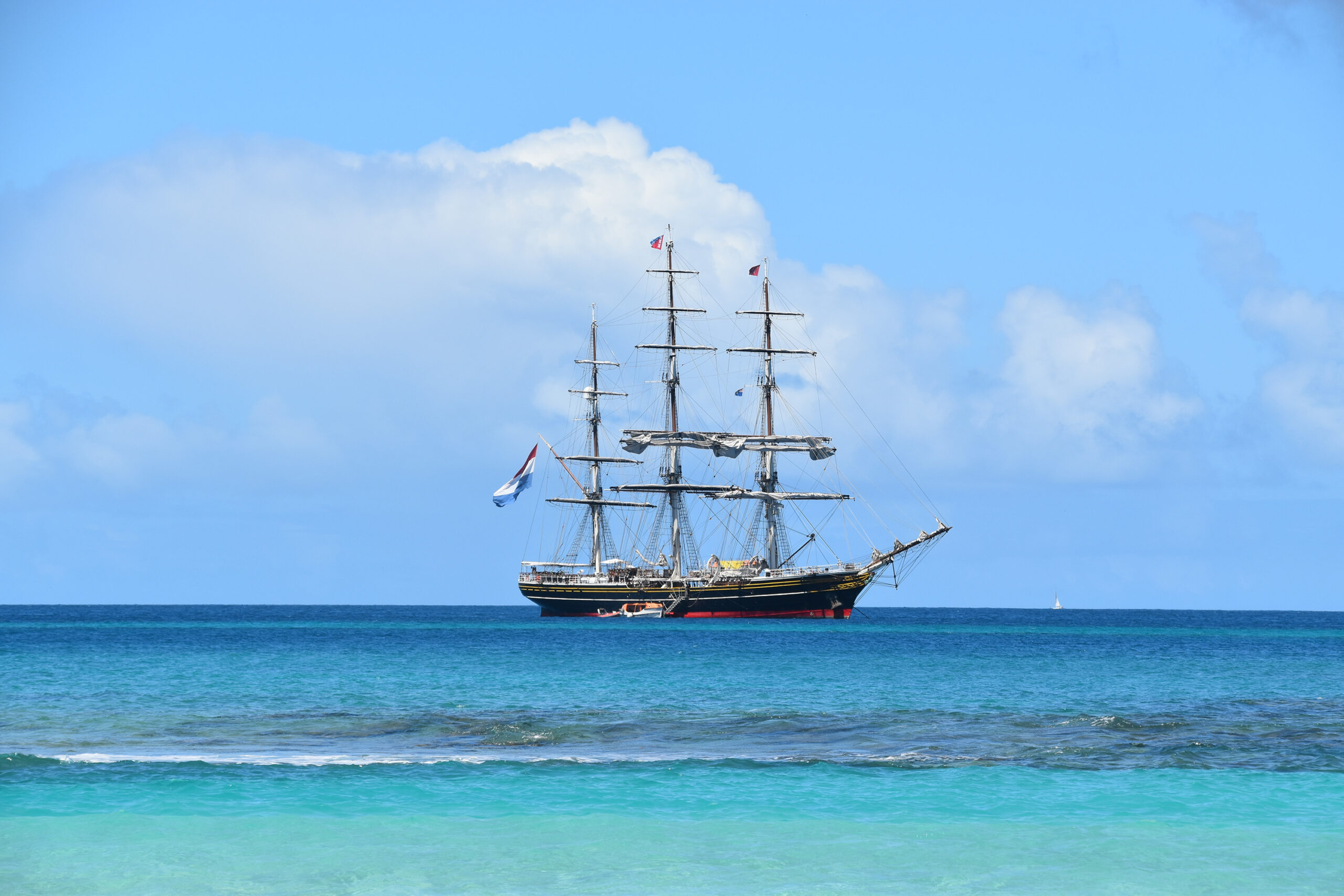
Sailing in the Caribbean outside hurricane season with Clipper Stad Amsterdam
We deliberately plan our luxury sailing cruises in the Caribbean during the safest and most beautiful time of year: January and February. This way we combine optimal sailing enjoyment with the tranquility and beauty of the islands, well outside hurricane season.
Here is what you can expect on board:
- A maximum of 28 guests spread across 14 private cabins, for an intimate and personal stay
- Sailing by wind and power during the day, anchoring in the evening in secluded bays inaccessible to large cruise ships
- Fully catered: breakfast, lunch, dinner, and cocktails prepared by our own chefs on board
- Activities such as snorkeling, day trips, and relaxing on white sandy beaches
- A young, dedicated crew that still sails manually and authentically
We offer various routes in the Caribbean. We sail from Sint Maarten to Martinique, passing beautiful islands in the Lesser Antilles. Another option is the route from Tobago to Martinique, where you explore the more southerly part of the island chain. And for those who want to sail the reverse direction, we also offer the route from Martinique to Tobago. Each route has its own character and ports of call.
Would you like to know more or are you curious which route suits you best? Contact us and we will be happy to help.
Frequently Asked Questions
What happens to my cruise if a hurricane approaches during my trip?
If a hurricane threatens the planned route, the captain has the authority and responsibility to adjust course immediately. Cruise lines have emergency protocols in place for this, including alternative ports of call and sheltered anchorage areas. Your booking is in most cases protected through the cruise line’s terms and conditions, but it is always wise to also take out travel insurance that covers weather-related cancellations.
Is travel insurance required during hurricane season in the Caribbean?
Travel insurance is formally rarely mandatory, but during hurricane season (June through November) it is plainly unwise to travel without it. Make sure to get insurance that specifically covers cancellation due to extreme weather conditions and trip interruptions. Read the policy terms carefully, as not all standard insurance policies automatically cover hurricane damage.
Are the ABC islands (Aruba, Bonaire, Curaçao) really safe during hurricane season?
The ABC islands lie south of the hurricane belt and are statistically rarely directly struck by hurricanes. However, ‘rarely’ does not mean ‘never’: in exceptional cases, a hurricane can also veer further south. The risk is considerably lower than for islands such as Sint Maarten or Puerto Rico, but a small chance always remains. For maximum peace of mind, traveling outside hurricane season remains the wisest choice.
How far in advance should I book a Caribbean cruise to secure the best spots?
For a cruise during high season (December through April), it is advisable to book at least six to twelve months in advance, especially on smaller ships with limited capacity. Popular departure dates in January and February are often fully booked early on. Booking early also gives you more freedom of choice in cabin types and itineraries, and sometimes offers early-booking advantages.
What is the difference between sailing on a small sailing ship versus a large cruise ship during hurricane season?
Small sailing ships are more maneuverable and can respond more quickly to changing weather conditions by seeking shelter in protected bays that are inaccessible to large cruise ships. Large cruise ships, on the other hand, have more technological resources and stabilizers, but are less flexible when it comes to route changes. Outside hurricane season, this difference barely plays a role, and small ships offer a more intimate and authentic experience.
Can I track the latest hurricane forecasts myself as a traveler?
Yes, you can easily do so through reliable sources such as the American National Hurricane Center (nhc.noaa.gov), which publishes daily updates on active storms and seasonal forecasts. The KNMI and Buienradar also offer weather information for the region. If you have a cruise booked, the cruise line will generally keep you actively informed of any route changes.
Which personal belongings or documents should I protect extra carefully when traveling to the Caribbean during hurricane season?
Always keep digital backups of your travel documents, insurance papers, and booking confirmations, stored in the cloud or emailed to yourself. Store original documents in a waterproof bag or folder on board. Also bring a small emergency kit with a flashlight, extra medications, and some local currency, in case ports of call are temporarily unreachable or facilities are limited.