

Which cruise line is the best?
There is no single best cruise line for everyone. The right choice depends entirely on what you are looking for in a cruise holiday: adventure or relaxation, a large ship with extensive facilities or an intimate experience with a small group. Discerning travellers who want to avoid mass tourism increasingly opt for small-scale alternatives such as a luxury sailing cruise. In this article we answer the most frequently asked questions to help you make the right choice.
What makes a cruise line truly good?
A good cruise line distinguishes itself through the combination of reliable service, a unique experience and transparency about what you can expect. The best companies offer not only a comfortable journey, but also a sense of connection with the destination, the sea and the people on board. That goes beyond a beautiful ship or a packed programme.
Concretely, you can evaluate a cruise line on the following points:
- Service quality: Is the crew genuinely engaged, or does it feel like an anonymous hotel at sea?
- Group size: The more passengers, the less personal the experience tends to be.
- Authenticity: Does the style of the cruise match your travel values?
- Destinations: Does the ship visit unique anchorages or only busy port cities?
- Sustainability: How does the company manage its impact on the environment?
A cruise holiday is an investment in time and experience. It is therefore important that the company meets your expectations, not only on paper, but also in practice on board.
What is the difference between large and small cruise ships?
The biggest difference between large and small cruise ships lies in the atmosphere and the type of experience. Large cruise ships carry thousands of passengers and offer a wide range of entertainment and facilities. Small ships carry dozens of passengers and emphasise personal contact, exceptional destinations and an intimate atmosphere on board.
Large cruise ships are ideal for travellers who value variety in activities, multiple restaurants and a lively atmosphere. They often dock in major port cities with well-developed tourist infrastructure.
Small cruise ships have different advantages:
- They can anchor in remote bays that are inaccessible to large ships.
- The ratio of crew to passengers is far more favourable, leading to more personal service.
- Fellow travellers form a small, like-minded group, which benefits the atmosphere on board.
- The programme is more flexible and can be adapted to the weather or the wishes of the group.
For travellers looking for a genuine cruise holiday with character, small ships generally offer a richer and more meaningful experience.
Which cruise line is best for luxury travellers?
For luxury travellers, the best cruise lines are those that combine a high level of service with exclusivity and a unique experience. That does not necessarily mean a large ship. Boutique-style cruises in particular score highly among travellers who are accustomed to quality and will not settle for the average.
Luxury in the cruise world does not always mean the largest suite or the most entertainment. For many travellers it is about:
- Personal attention from an engaged crew
- High-quality meals prepared by experienced chefs on board
- Peace and space without crowds or queues
- Destinations that not everyone reaches
- A ship with its own story and character
Major luxury cruise lines such as Silversea, Seabourn and Regent Seven Seas are well-known names in the premium segment. But more and more luxury travellers are deliberately choosing a different category: the historic sailing cruise, where the ship itself is part of the experience.
How do you choose the right cruise for your travel goal?
You choose the right cruise by first determining what you want to experience, not just where you want to go. Ask yourself: do I want to relax, seek adventure, immerse myself in culture, or put the sea itself centre stage? From that answer you can search purposefully for the type of ship and company that fits.
A practical approach:
- Determine your travel party. Are you travelling alone, with a partner, friends or family? The composition of the group partly determines which type of cruise is most enjoyable.
- Choose a destination that appeals to you. The Caribbean, the Mediterranean and Northern Europe each offer a very different atmosphere and type of destination.
- Think about scale. Do you want the anonymity of a large ship, or the intimacy of a small group?
- Set your priorities. A cruise holiday carries exclusive pricing depending on the season, ship category and duration. Get in touch for a personalised quote tailored to your wishes.
- Read experiences from other travellers. Not only the descriptions from the company itself, but also independent reviews give a more honest picture.
What are the advantages of a sailing cruise compared with a regular cruise?
A sailing cruise offers a fundamentally different experience from a regular cruise. Instead of a floating hotel carrying thousands of passengers, you travel on a ship that truly sails, driven by the wind, with a small group on board. The connection with the sea, the rhythm of the journey and the authenticity of sailing make it an experience in its own right.
Intimacy and personal contact
On a sailing cruise, a maximum of a few dozen passengers travel together. This creates a completely different dynamic: you genuinely get to know your fellow travellers, the crew knows you by name and the programme is flexible. There are no queues, no anonymous buffets and no feeling of being one of thousands.
Unique destinations and freedom
Sailing ships can anchor in places that are inaccessible to large cruise ships: remote bays, small islands and quiet coastal towns. During the day you sail; in the evening you lie at anchor in a tranquil bay. This gives a sense of freedom and adventure that a regular cruise holiday rarely offers.
Why do travellers choose Clipper Stad Amsterdam?
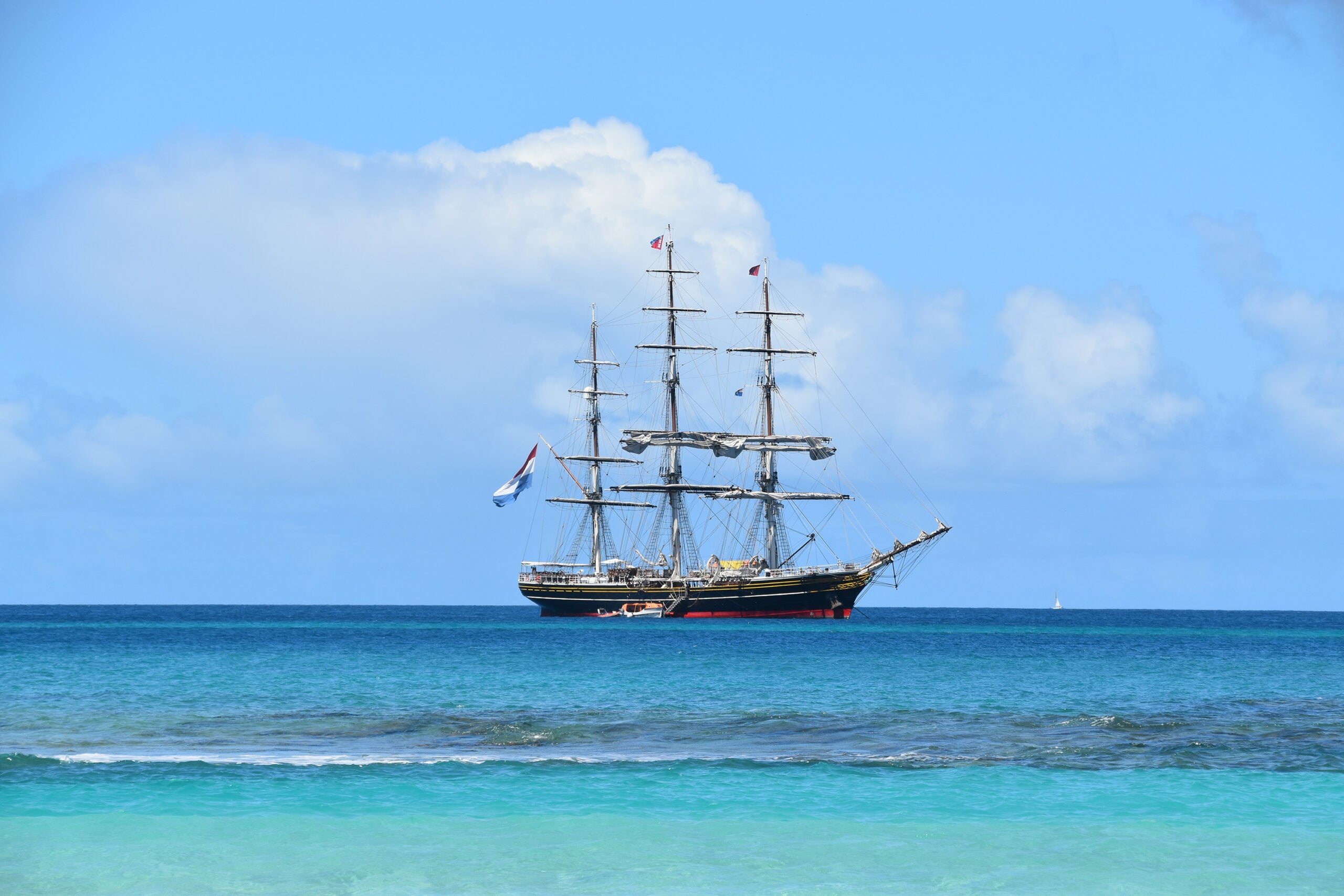
Travellers choose Clipper Stad Amsterdam because the ship offers something that cannot be found anywhere else: the combination of an authentic historic sailing ship, a high level of service and an intimate atmosphere with a maximum of 28 passengers on board. It is not an ordinary cruise, but an experience in which the ship itself plays the leading role.
What our guests appreciate most:
- Authentic sailing: The sails are handled manually by a young, enthusiastic crew. Guests are welcome to help actively if they wish.
- Boutique hotel feel: 14 luxury cabins, personal service and meals prepared by chefs on board. Breakfast, lunch and dinner are included.
- Unique destinations: We anchor in remote bays in the Caribbean, far from crowds and mass tourism.
- Small group: A maximum of 28 passengers, ensuring peace, space and genuine connection with fellow travellers and crew.
- Sustainable choice: We sail on HVO (Hydrotreated Vegetable Oil) where possible, as part of our commitment to more sustainable navigation.
Our luxury sailing cruise in the Caribbean is the ideal product for travellers who are done with anonymous all-inclusive holidays and are looking for something truly special. The cruise is an exclusive premium product with bespoke pricing depending on duration, cabin category and departure date, and is aimed at travellers who place quality and experience above quantity. Get in touch for a personalised quote.
Would you like to know more or are you ready to plan your trip? Book your trip directly online, or contact us for personal advice.
Frequently Asked Questions
Hoe ver van tevoren moet ik een luxe zeilcruise boeken?
Voor een premium product zoals een luxe zeilcruise met beperkte capaciteit — zoals de Clipper Stad Amsterdam met slechts 28 plaatsen — is het verstandig om minimaal 6 tot 12 maanden van tevoren te boeken. Populaire vertrekdata in het hoogseizoen (december t/m april in het Caribisch gebied) zijn vaak al vroeg volgeboekt. Vroeg boeken geeft je ook de beste keuze uit beschikbare hutten en de meeste tijd om je reis goed voor te bereiden.
Is een zeilcruise ook geschikt als ik geen zeilerservaring heb?
Absoluut. Je hebt geen enkele zeilerservaring nodig om te genieten van een zeilcruise. Op schepen zoals de Stad Amsterdam zorgt een professionele bemanning voor alles wat met het varen te maken heeft. Wil je actief meehelpen met de zeilen? Dat mag en wordt zelfs aangemoedigd. Maar ontspannen op het dek terwijl het schip door de wind wordt voortgedreven is minstens zo waardevol.
Wat is het verschil tussen een all-inclusive cruise en een premiumcruise zoals de Stad Amsterdam?
Bij een traditionele all-inclusive cruise betaal je een basisbedrag waarbij veel extra’s — zoals dranken, uitstapjes en specialiteitsrestaurants — apart worden afgerekend. Bij een premiumcruise zoals de Stad Amsterdam zijn maaltijden, dranken en de volledige beleving aan boord inbegrepen in de prijs, zonder verborgen kosten. Het grootste verschil zit echter in de kwaliteit van de ervaring: persoonlijke service, kleine groepen en unieke bestemmingen die je bij een standaard all-inclusive vakantie simpelweg niet vindt.
Welke bestemmingen worden aangedaan tijdens een luxe zeilcruise in het Caribisch gebied?
Een luxe zeilcruise in de Caraïben legt typisch aan op afgelegen eilanden en in rustige baaien die voor grote cruiseschepen ontoegankelijk zijn, zoals kleinere eilanden in de Leeward en Windward Islands. Denk aan plaatsen als Anguilla, Sint-Barths, Dominica of de Tobago Cays — bestemmingen met een ongerepte natuur, helder water en nauwelijks massatoerisme. De exacte route kan variëren per vertrekdatum en is mede afhankelijk van wind en weersomstandigheden, wat de reis juist avontuurlijk en authentiek maakt.
Wat moet ik meenemen op een zeilcruise en hoe groot mag mijn bagage zijn?
Op een zeilcruise is compacte, soepele bagage een must. Harde koffers zijn lastig te stouwen in de beperkte ruimtes aan boord; een zachte reistas of duffel bag werkt veel beter. Qua kleding: denk aan luchtige, casual outfits, een goede zonnebrandcrème, zwemkleding en een lichte avondoutfit voor de dinertafel. Nautische kledingvoorschriften zijn doorgaans relaxed, maar een nette casual stijl wordt op premiumschepen gewaardeerd.
Hoe duurzaam is een zeilcruise in vergelijking met een traditionele cruise?
Een zeilcruise heeft van nature al een kleinere ecologische voetafdruk dan een grote cruisemaatschappij, simpelweg vanwege de kleinere schaalgrootte en het gebruik van windkracht als primaire energiebron. Schepen die daarnaast ook varen op duurzamere brandstoffen zoals HVO (Hydrotreated Vegetable Oil) gaan nog een stap verder in het verminderen van CO₂-uitstoot. Wil je als reiziger een bewustere keuze maken, dan is een kleine zeilcruise met een duurzaamheidsstrategie een van de meest verantwoorde opties binnen de cruisewereld.
Is een luxe zeilcruise geschikt voor koppels, of ook voor solo-reizigers en kleine groepen?
Een luxe zeilcruise is uitstekend geschikt voor zowel koppels als solo-reizigers en kleine vriendengroepen. De intieme setting — met slechts een handvol medereizenden — maakt het voor solo-reizigers juist gemakkelijk om echte verbindingen te leggen met gelijkgestemde mensen. Koppels waarderen de rust, de romantische ankerplaatsen en de persoonlijke sfeer. Kleine groepen of vriendengezelschappen kunnen soms ook een volledige cruise privé boeken voor een exclusieve groepservaring.