

What are popular destinations for boat holidays?
The most popular destinations for a boat holiday are the Caribbean, the Mediterranean, the Greek islands, and the Norwegian fjords. Which destination suits you best depends on the kind of experience you are looking for: adventurous sailing, relaxing at anchor in secluded bays, or exploring cultural harbour towns. In this article we answer the most frequently asked questions about a holiday on a boat, so you can make your choice fully prepared.
What types of destinations are suitable for a boat holiday?
For a boat holiday, tropical waters, European coastlines, and open ocean routes are all suitable options. The choice depends on the type of sailing waters, the climate, and the desired duration of travel. Broadly speaking, there are three categories: tropical destinations with warm water and anchorages, European coastal destinations with historic harbours, and ocean routes for true adventurers.
Tropical destinations such as the Caribbean attract sailors because of the stable trade winds, clear water, and calm anchorages. European coastlines, from the Adriatic Sea to the Atlantic coast of Portugal, offer a combination of culture, nature, and varied sailing conditions. Ocean routes, such as the crossing from Europe to the Caribbean, are for travellers who want to experience real adventure on the open sea.
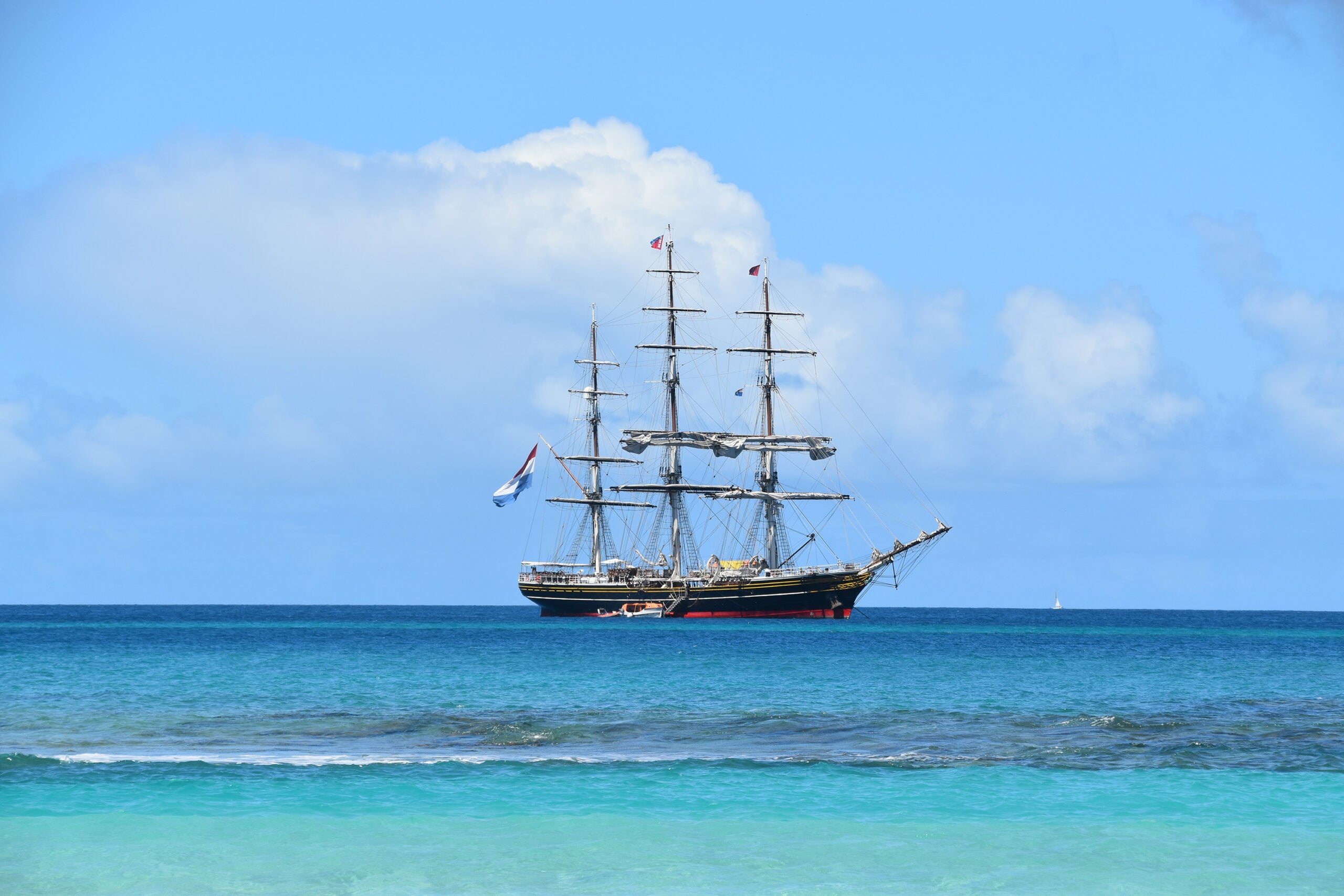
Beyond the sailing waters, the type of vessel also plays a role. A traditionally rigged sailing ship has different possibilities than a modern motor yacht. On a traditional clipper ship you experience the sea in an entirely different way: the sailing is manual and authentic, you feel the ship respond to wind and waves, and every arrival in a new harbour feels like a genuine discovery.
What are the most popular destinations in Europe for a boat holiday?
The most popular European destinations for a boat holiday are the Greek islands, the Croatian coast, the Balearic Islands, the Azores, and the Norwegian fjords. These areas combine varied sailing conditions with stunning nature and accessible harbours. For sailors looking for more of a challenge, the Atlantic coast of Portugal and the Scottish islands are also popular choices.
Greece and Croatia
The Greek islands have been one of the favourite destinations for sailors for decades. The Aegean Sea offers stable winds, a large number of islands to explore, and a rich cultural history. Croatia is attracting an increasing number of sailors thanks to the clear Adriatic waters, well-equipped marinas, and historic coastal cities such as Dubrovnik and Split.
The Azores and the Norwegian fjords
The Azores are ideal for travellers who want to avoid the crowds of the Mediterranean. This Portuguese island archipelago in the middle of the Atlantic Ocean offers spectacular nature, whale watching, and an authentic atmosphere. The Norwegian fjords are unrivalled for those seeking impressive landscapes and tranquil sailing waters, although the Northern European climate requires thorough preparation.
Why is the Caribbean so popular for a sailing holiday?
The Caribbean is so popular for a sailing holiday because it combines stable trade winds, warm temperatures, crystal-clear blue water, and a large number of sheltered anchorages. Travellers find a perfect mix of sailing, snorkelling, relaxing on white beaches, and exploring colourful islands, all year round.
The trade winds blow from almost the same direction at all times, making sailing predictable and pleasant. Islands such as the British Virgin Islands, Sint Maarten, Martinique, and the Grenadines are relatively close to one another, so you can reach a new destination every day without having to cross open sea for days on end.
What also makes the Caribbean special is its variety. Each island has its own character: French Caribbean islands have a European feel, while smaller, lesser-known islands remain completely unspoilt. Anchoring in a secluded bay, surrounded by jungle and coral reefs, is an experience you simply cannot have on a large cruise ship.
When is the best time to plan a boat holiday?
The best time for a boat holiday in the Caribbean is from November to April, during the dry season with stable trade winds and little chance of tropical storms. For European destinations, the period from May to September is most suitable, with the most pleasant temperatures and the best sailing conditions.
In the Caribbean, the wet season from June to November coincides with hurricane season. Although hurricanes are relatively rare, it is wise to plan outside this season for the most relaxed and safe sailing experience. The dry months also offer the clearest water, ideal for snorkelling and diving.
For Europe, June, July, and August are the busiest months in popular destinations such as Greece and Croatia. Those who want to avoid the crowds should opt for May or September. During those months the weather is still pleasant, the harbours are less crowded, and the atmosphere is more relaxed. For Scandinavian destinations, the summer months of June to August are the only realistically suitable season.
What is the difference between a day trip and a multi-day sailing holiday?
A day trip is a short sailing experience lasting a few hours to a full day, with no overnight stay on board, whereas a multi-day sailing holiday involves several nights on the vessel and makes genuine travel between destinations possible. The biggest difference lies in the depth of the experience: a day trip is an introduction, a multi-day journey is a truly adventurous experience.
On a day trip you get to know the ship, the crew, and the feeling of sailing. It is a low-threshold way to discover whether sailing is right for you, without a major time commitment. Day trips are often offered from harbour towns and are suitable for all ages and experience levels.
A multi-day sailing holiday goes much further. You sleep on board, experience the rhythm of the ship over several days, watch the sun rise at sea, and anchor in a quiet bay in the evening. You build a real bond with the crew and your fellow travellers. The destination becomes not just the end point — the journey itself becomes an unforgettable experience.
How do you choose the right boat holiday for your travel group?
You choose the right boat holiday by looking at the group size, the desired destination, the experience level of the participants, and the type of experience the group is looking for. Ask yourself: do you want to sail actively or relax on board, and how important are comfort and service to the group?
For couples or small groups seeking luxury and privacy, a vessel with a limited number of cabins is ideal. A smaller group on board means more personal contact with the crew, more peace and quiet, and a more intimate atmosphere. For larger families or groups of friends, having enough space and a sociable environment is a real benefit.
Consider the experience level as well. Experienced sailors may prefer a more active role on board, while beginners are better served on a ship where the crew takes full care of the sailing. Finally, the climate of the destination is an important factor, especially if the group includes children or older travellers who may be more sensitive to extreme heat or rough seas.
How Clipper Stad Amsterdam helps you choose your boat holiday
We offer a distinctive answer to the question of a true holiday on a boat: a multi-day luxury sailing cruise on board an authentic three-masted clipper ship. No mass tourism, no anonymous large cruise ships, but an intimate and adventurous journey with a maximum of 28 passengers in 14 cabins.
What sets our cruises apart:
- Sailing on the open sea by day, anchoring in secluded bays in the Caribbean by evening
- Fully catered on board: breakfast, lunch, and dinner prepared by our chefs
- Activities such as snorkelling, day excursions, and relaxing on white beaches
- A young, dedicated crew that carries out the sailing manually and authentically
- A boutique hotel feel on board, with a high level of service in an approachable atmosphere
- Available for couples, groups of friends, and anyone looking for a unique sailing experience
Our rates are tailored exclusively to season, cabin category, and duration of travel. Contact our team for a personalised quote, or book your trip directly online.
Frequently Asked Questions
Heb ik zeilervaring nodig om mee te gaan op een meerdaagse zeilvakantie?
Nee, zeilervaring is absoluut niet vereist voor een meerdaagse zeilvakantie aan boord van een volledig bemand schip. De professionele bemanning verzorgt het volledige zeilen, van het hijsen van de zeilen tot het navigeren en het ankeren. Jij kunt gewoon genieten van de reis, of je nu wilt meekijken en leren of liever ontspant op het dek.
Wat moet ik inpakken voor een bootvakantie in het Caribisch gebied?
Voor een Caribische bootvakantie pak je lichte, sneldrogende kleding in, een goede zonnebrandcrème (bij voorkeur rifreinigend), een zonnehoed, zonnebril en comfortabele, niet-krassende schoenen voor aan boord. Vergeet ook niet je zwemspullen, een lichte regenjas voor tropische buien en eventueel zeeziektepleisters als je gevoelig bent voor beweging op het water. Houd je bagage compact, want de opbergruimte in scheepshutten is doorgaans beperkt.
Wat als ik last krijg van zeeziekte tijdens de reis?
Zeeziekte is een veelvoorkomende zorg, maar in de praktijk valt het voor de meeste mensen mee, zeker in rustige, beschutte wateren zoals het Caribisch gebied. Preventieve maatregelen zoals zeeziektepleisters of -tabletten (verkrijgbaar bij de apotheek) helpen effectief als je ze op tijd inneemt. Aan boord helpt het om op het dek te blijven, naar de horizon te kijken en voldoende water te drinken; de bemanning is bovendien goed getraind om je te begeleiden als je je niet lekker voelt.
Hoe ver van tevoren moet ik mijn bootvakantie boeken?
Voor een populaire bestemming zoals het Caribisch gebied is het verstandig om minimaal drie tot zes maanden van tevoren te boeken, zeker voor reizen in het hoogseizoen van november tot april. Kleinschalige schepen met een beperkt aantal plaatsen, zoals een klipperschip met slechts 28 passagiers, zijn vaak vroeg volgeboekt. Vroeg boeken geeft je ook meer keuze in vertrekdata en hutten.
Is een bootvakantie ook geschikt voor mensen die niet kunnen zwemmen?
Ja, ook niet-zwemmers kunnen volop genieten van een bootvakantie. Aan boord zijn reddingsvesten beschikbaar en de bemanning houdt altijd toezicht bij wateractiviteiten. Snorkeluitstapjes zijn vrijwillig, dus je bepaalt zelf of en in hoeverre je het water in gaat. De beleving aan boord zelf, het zeilen, de landschappen, de havens en het sociale aspect, is volledig te genieten zonder dat je ooit het water in hoeft.
Wat is het verschil tussen een zeilvakantie op een klipperschip en het huren van een privéjacht?
Bij het huren van een privéjacht huur je doorgaans een kleiner motorjacht of zeilboot, al dan niet met schipper, en bepaal je zelf de route en het tempo. Een klipperschip biedt een heel andere, authentiekere zeilbeleving: je vaart op een historisch getuigd schip met handmatig zeilen, een vaste bemanning en een gestructureerd reisprogramma. Het klipperschip combineert avontuur met comfort en een sociale sfeer, terwijl een privéjacht meer vrijheid en privacy biedt maar ook meer eigen verantwoordelijkheid.
Zijn er bootvakantie-opties geschikt voor mensen met een beperkte mobiliteit?
Dit verschilt sterk per schip en bestemming. Sommige schepen zijn beter toegankelijk dan andere, afhankelijk van de indeling van de hutten, het aantal trappen en de toegang tot het dek. Het is altijd verstandig om bij de aanbieder specifiek te vragen naar de toegankelijkheid van het schip en de activiteiten. Een kleinschalig schip met een persoonlijke bemanning heeft als voordeel dat er meer ruimte is voor maatwerk en individuele begeleiding.