
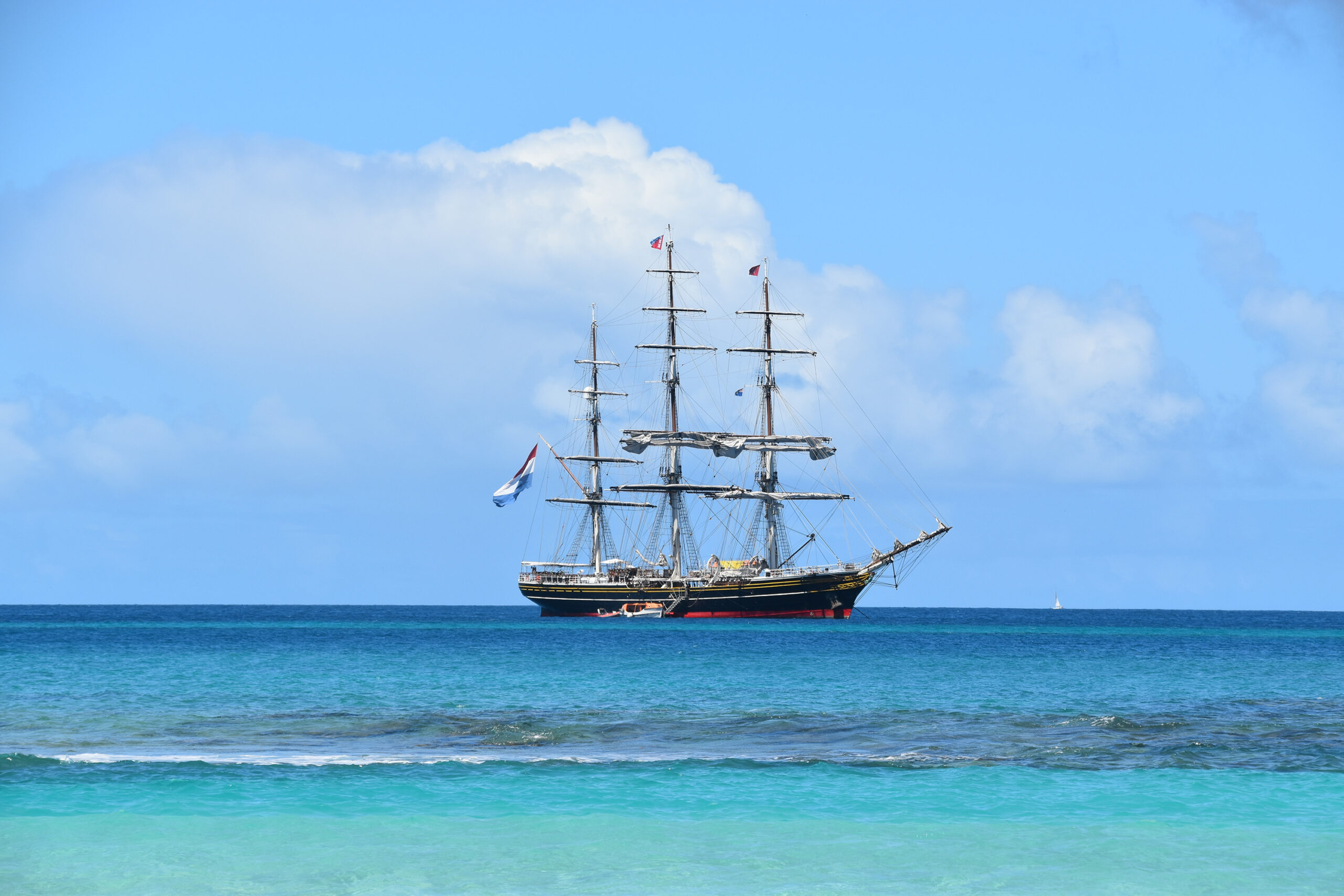
Sailing cruise from the Canary Islands to the Caribbean
A sailing cruise from the Canary Islands to the Caribbean takes an average of 18 to 25 days, depending on the vessel, the route, and weather conditions. The crossing follows the classic trade wind route across the Atlantic Ocean, one of the most iconic sailing voyages in the world. In this article, we answer the most frequently asked questions about this transatlantic crossing.
How long does a sailing cruise from the Canary Islands to the Caribbean take?
A sailing cruise from the Canary Islands to the Caribbean typically takes 18 to 25 days at sea. The exact duration depends on the type of vessel, the chosen route, and the strength of the trade winds. Faster ships, such as a clipper, can complete the crossing considerably more quickly than an average sailing vessel.
A traditionally rigged sailing ship like a clipper sails at 15 knots with ease in good wind. That makes a significant difference compared to smaller or slower sailing boats, which are often underway for longer. The distance from the Canary Islands to the Caribbean is roughly 2,700 to 3,000 nautical miles, depending on the point of departure and the final destination.
Expect to be almost continuously on the open ocean throughout the crossing. That is precisely what appeals to many travellers: the pure experience of the ocean, without distraction, with the wind in the sails and the starry sky above your head.
What are the best departure months for a transatlantic crossing?
The best departure months for a sailing cruise from the Canary Islands to the Caribbean are November and December. During this period, the trade winds are at their most stable and reliable, providing comfortable and favourable sailing conditions. Departing earlier than November increases the risk of tropical storms in the Caribbean.
The Atlantic hurricane season officially runs from June through November, but the likelihood of hurricanes decreases sharply after mid-November. Most sailors therefore depart around the end of November or the beginning of December from Gran Canaria or Tenerife. This way, they arrive in the Caribbean at Christmas or the new year, which is a special experience in itself.
Those departing in January or February can still count on good trade winds, though the chance of less consistent wind is slightly higher. The advantages of a later departure are the warmer temperatures in the Caribbean and the opportunity to enjoy the Caribbean season for longer, which runs until April.
Which route do sailing ships follow from the Canary Islands to the Caribbean?
Sailing ships follow the classic trade wind route from the Canary Islands to the Caribbean, also known as the Trade Wind Route. Ships first sail southward along the African coast to pick up the trade winds, then cross the Atlantic Ocean westward toward the Lesser Antilles.
The most commonly used arrival points in the Caribbean are Barbados, Sint Maarten, and Martinique. These islands are strategically located at the eastern end of the Caribbean island arc and are therefore the natural endpoints of the transatlantic crossing. Barbados is historically the most popular arrival point for transatlantic sailors.
The route that Christopher Columbus followed in 1492 is, in broad outline, still the same today. This gives the crossing a special historical dimension. You sail literally across the same ocean, making use of the same winds that enabled centuries of trade.
What can you expect on board during an ocean crossing?
During a transatlantic ocean crossing, you trade the bustle of daily life for the rhythm of the sea. On board, everything revolves around the voyage, nature, and the community of people making the journey together. Do not expect luxury port visits, but do expect an intensive, immersive sailing experience on the open ocean.
The daily schedule on board is structured around the watch. Everyone on board takes part in the watch system, including passengers who wish to do so. You learn to steer the helm, trim the sails, and read the stars. In between, there is plenty of time to read, relax, and get to know new people.
On a ship like the Stad Amsterdam, guests are looked after by a hospitality team that is on hand throughout the entire voyage. Think freshly prepared breakfast, lunch, and dinner, and drinks on deck as the sun goes down. With a maximum of 42 passengers on board during an Atlantic crossing (14 cabins, up to 3 persons per cabin), the company is small and the atmosphere intimate.
Who is a sailing cruise to the Caribbean suited for?
A sailing cruise to the Caribbean is suited to travellers who seek adventure while also valuing comfort and companionship. You do not need to be an experienced sailor. You do, however, need to enjoy life at sea, be open to a varying daily rhythm, and be willing to live within a small community for an extended period of time.
The crossing is not suited to travellers who require constant activities, port visits, or the distractions of a large cruise ship. On the open ocean, the ship is your world. That calls for a degree of mental flexibility and a willingness to let go.
People who make the crossing are often looking for a milestone. It is a journey that stays with you, an experience that changes you. Travellers between 35 and 65 who have grown tired of standard holidays and want something genuine find exactly what they were looking for in the transatlantic crossing.
How does a sailing cruise on a clipper differ from an ordinary cruise?
A luxe zeilcruise on a clipper differs fundamentally from an ordinary cruise. Where a regular cruise ship runs on engine power, mass, and entertainment, a clipper sails on wind, authenticity, and experience. The ship is smaller, the company is intimate, and the experience is personal.
Scale and atmosphere
A large cruise ship carries thousands of passengers and offers the anonymity of a floating hotel. A clipper like the Stad Amsterdam has 14 cabins and takes a maximum of 42 passengers on an ocean crossing. Everyone knows one another, the crew knows you by name, and there are no queues or numbered tickets.
Sailing as an experience
On a clipper, sailing is not the backdrop but the very heart of the journey. The sails are operated by hand by an engaged, young crew. You see the work, you hear the ship, you feel the wind. That is an entirely different experience from watching the horizon from a deck twelve metres above the water.
Moreover, a clipper offers a different kind of luxury: not the luxury of excess, but the luxury of space, silence, and authenticity. The high level of service on board, combined with the historic character of the ship, makes it a boutique experience at sea.
How Clipper Stad Amsterdam takes you across the Atlantic Ocean
Clipper Stad Amsterdam offers one of the most remarkable ways to make the crossing from the Canary Islands to the Caribbean. On board this iconic three-masted clipper ship, you combine the romance of historic sailing with the comfort of a modern boutique hotel at sea.
- Maximum of 42 passengers on board during the Atlantic crossing, spread across 14 cabins
- Fully catered: breakfast, lunch, and dinner prepared by the chefs on board
- Hand sailing with a young, friendly, and dedicated crew
- Authentic clipper with modern safety and comfort facilities
- Winner of the Cutty Sark Tall Ships’ Race 2001
The transatlantic crossing is a journey you will never forget. Are you ready to cross the ocean? View our offering and book your voyage directly online, or get in touch for personal advice about the possibilities on board.
Frequently Asked Questions
Heb ik zeilervaringen nodig om mee te gaan op de trans-Atlantische oversteek?
Nee, voorafgaande zeilervaringen zijn niet vereist. Aan boord van de Stad Amsterdam word je begeleid door een ervaren bemanning die je stap voor stap meeneemt in het zeilproces. Je leert al doende: van het bedienen van het roer tot het bijstellen van de zeilen. Enthousiasme en een open houding zijn belangrijker dan technische kennis.
Wat moet ik inpakken voor een oceaanoversteek van 18 tot 25 dagen?
Pak functioneel en compact in, want de ruimte in de hutten is beperkt. Denk aan waterdichte kleding, warme lagen voor de nachtwachten, zonnebescherming en stevige, antislip schoenen met witte zolen voor op het dek. Vergeet ook niet een goede koortsvrije medicatie tegen zeeziekte mee te nemen, zeker voor de eerste dagen op open oceaan wanneer je lichaam nog moet wennen aan het schip.
Wat als ik last krijg van zeeziekte tijdens de oversteek?
Zeeziekte is een veelvoorkomend verschijnsel in de eerste twee tot drie dagen van de oversteek, ook bij mensen die dachten er geen last van te krijgen. Preventieve medicatie zoals cinnarizine of een pleisters achter het oor helpen de meeste mensen goed door de aanwenperiode heen. Na een paar dagen past het lichaam zich aan het bewegingsritme van het schip aan, en verdwijnen de klachten bij de meeste passagiers vanzelf.
Is er internet of telefoonverbinding beschikbaar tijdens de oversteek?
Op open oceaan is de internetverbinding beperkt of afwezig, afhankelijk van de satellietdekking. Dat is voor veel reizigers juist een van de aantrekkelijke kanten van de oversteek: de gedwongen digitale detox. Urgente berichten kunnen via de scheepsradio worden verzonden, maar reken er niet op dat je dagelijks verbonden bent. Informeer vooraf bij de rederij naar de actuele communicatiemogelijkheden aan boord.
Hoe zit het met de veiligheid op een zeilschip midden op de Atlantische Oceaan?
Moderne klippers zoals de Stad Amsterdam zijn uitgerust met alle verplichte en aanbevolen veiligheidsvoorzieningen, waaronder reddingsvlotten, EPIRB-noodbeacons, AIS-transponders en een volledig getrainde bemanning in veiligheidsprocedures. Vóór vertrek krijgen alle passagiers een uitgebreide veiligheidsbriefing. De route over de Atlantische Oceaan via de passaatwindroute is bovendien een van de meest bevaren en voorspelbare oceaanroutes ter wereld.
Kun je tussentijds van boord gaan of de reis onderbreken?
Tijdens de open oceaanoversteek zijn er geen tussenstops en is het niet mogelijk van boord te gaan. De reis van de Canarische Eilanden naar de Cariben is een aaneengesloten passage op zee. Het is daarom belangrijk dat je zeker bent van je beslissing voordat je aan boord stapt. Bespreek eventuele twijfels of bijzondere omstandigheden altijd vooraf met de rederij.
Wat maakt het aankomstmoment in de Cariben zo bijzonder?
Na 18 tot 25 dagen op open oceaan is de eerste aanblik van een Caribisch eiland een onvergetelijk moment. De geur van tropische vegetatie, het turkooisblauw van het water en de warmte van de zon voelen na weken op zee bijna surrealistisch aan. Veel reizigers beschrijven het aankomstmoment als emotioneel en overweldigend, een ervaring die je alleen kunt begrijpen als je hem zelf hebt meegemaakt.