

What are the 5 largest cruise companies?
The five largest cruise companies in the world are Carnival Corporation, Royal Caribbean Group, MSC Cruises, Norwegian Cruise Line Holdings, and Disney Cruise Line. Together they dominate the vast majority of the global cruise market and carry tens of millions of passengers every year. In this article we answer the most frequently asked questions about these cruise lines, so you can make an informed choice for your next cruise holiday.
How many passengers do the largest cruise companies carry per year?
The largest cruise companies together carry more than 30 million passengers worldwide each year. Carnival Corporation alone, as the biggest player, carries more than 12 million guests annually across its many brands. Royal Caribbean Group follows with approximately 8 to 9 million passengers per year, while MSC Cruises has grown strongly in recent years and is now also approaching the 5 million mark.
These numbers immediately illustrate the enormous scale at which these cruise lines operate. Royal Caribbean’s newest mega-ships, such as the Wonder of the Seas, accommodate more than 6,000 passengers per sailing. That means stepping aboard a single ship quickly feels like entering a floating city, complete with shopping streets, theatres, water parks, and dozens of restaurants.
For travellers considering a cruise holiday, it is worth recognising that these figures also reveal the flip side of mass tourism at sea. The larger the ship, the more people on board, and the less personal the experience tends to be.
What is the difference between Carnival, Royal Caribbean, and MSC Cruises?
The biggest difference between Carnival, Royal Caribbean, and MSC Cruises lies in their positioning, target audience, and fleet strategy. Carnival has traditionally focused on a broad, price-conscious audience with an informal atmosphere. Royal Caribbean positions itself slightly higher in the segment and is known for technological innovation and spectacular ships. MSC Cruises is a European family business with a strong presence in the Mediterranean and a growing luxury division.
Carnival Corporation: broad and affordable
Carnival is not a single brand but a holding company that manages multiple brands, including Carnival Cruise Line, Costa Cruises, P&O Cruises, and Holland America Line. The emphasis is on accessibility and volume. The atmosphere on board is generally festive and informal, aimed at families and travellers who want plenty of entertainment for their money.
Royal Caribbean: innovation and spectacle
Royal Caribbean invests heavily in the largest and most technologically advanced ships in the world. Think surf simulators, climbing walls, robot bartenders, and indoor ski slopes. This brand attracts travellers who regard the cruise itself as an attraction, independent of the destinations visited.
MSC Cruises: European roots, international ambition
MSC Cruises distinguishes itself through its European character and a strong focus on the Mediterranean, although the company now operates worldwide. The brand has also launched a luxury segment under the name MSC Yacht Club, a ship-within-a-ship concept offering more exclusive service for those seeking greater privacy.
Which cruise company sails most in the Caribbean?
Royal Caribbean Group and Carnival Corporation are the two dominant players in the Caribbean. Both cruise lines have deployed a large portion of their fleets permanently on Caribbean routes, with home ports in Miami, Port Canaveral, and Fort Lauderdale. The Caribbean is the world’s most popular cruise destination, and that is precisely where the majority of large ships offer their itineraries.
The Caribbean routes of these companies typically revolve around private islands owned or managed by the cruise lines themselves, such as CocoCay by Royal Caribbean or Half Moon Cay by Holland America. This model gives the cruise lines complete control over the onshore experience, but it also means you rarely encounter genuine local culture. The islands are designed as an extension of the ship: controlled, commercial, and filled with fellow cruise guests.
What are the disadvantages of a large cruise company?
The biggest disadvantages of a cruise holiday with a large company are anonymity, crowds, and a lack of authenticity. On a ship carrying 3,000 to 6,000 passengers, it is difficult to have personal contact with the crew or fellow guests. Queues when disembarking, crowded buffets, and busy swimming pools are more the rule than the exception.
In addition, large cruise ships typically dock in busy commercial ports, far from the true heart of a destination. Time in port is limited, leaving little opportunity for a deeper exploration of the place. The excursions on offer are often standardised and taken simultaneously by hundreds of fellow passengers.
Another consideration is sustainability. Large cruise ships are notoriously taxing on the environment due to their fuel consumption, waste production, and the impact on fragile coastal areas and port cities. A growing number of travellers who want to travel responsibly regard this as a serious objection when choosing a cruise holiday.
When is a small sailing ship a better alternative to a large cruise?
A small sailing ship is a better alternative to a large cruise when you are looking for a personal, authentic, and adventurous experience. Where large cruise ships rely on scale and entertainment, a small sailing ship offers intimate contact with the sea, the destination, and the people around you. It is the better choice for travellers who want to avoid the anonymity of mass tourism.
On a small ship carrying no more than a few dozen guests, you know your fellow travellers by name within a day. The crew gives genuine attention to you as a guest, and the route can be adjusted more flexibly to suit the weather, the wind, and the wishes of the group. Instead of busy commercial ports, you anchor in a secluded bay in the evening, far from other tourists.
For travellers who want to discover the Caribbean in a way that truly differs from the standard cruise holiday, a luxury sailing cruise is a serious alternative worth considering. You experience the islands as they really are, at a relaxed pace and with the sound of wind in the sails as your backdrop.
How we offer an alternative to the large cruise companies
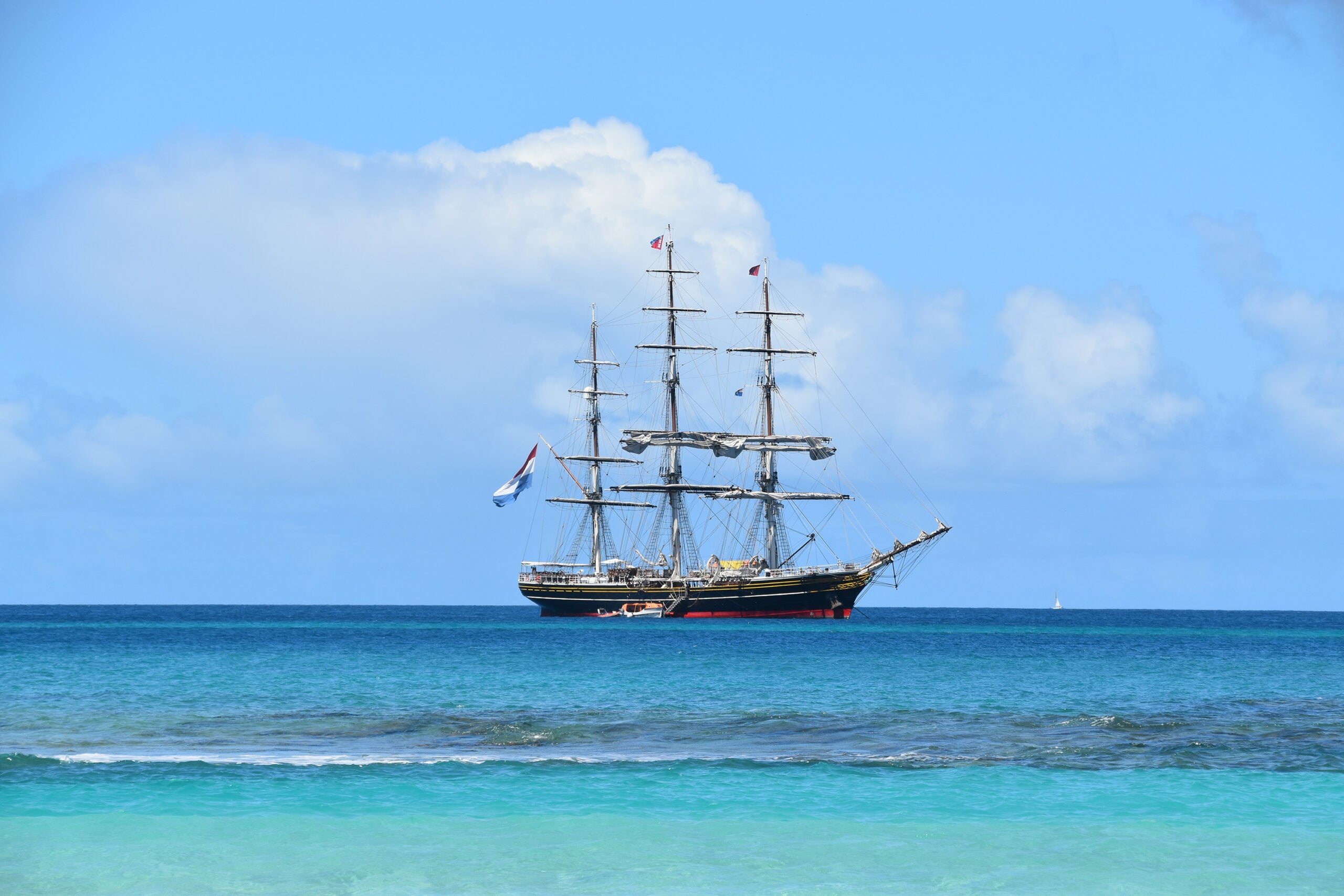
Clipper Stad Amsterdam is the opposite of a mega-ship. On board this iconic three-masted clipper ship, a maximum of 28 guests travel together, accommodated across 14 luxury cabins. That boutique hotel feeling at sea is exactly what travellers are looking for when they have grown tired of the anonymity of large cruise lines. This is what we offer:
- A maximum of 28 guests on board for an intimate, personal atmosphere
- Luxury cabins and a high level of service, including breakfast, lunch, and dinner prepared by our chefs
- Authentic sailing on a historic clipper ship with 31 sails and a total sail area of 2,200 square metres
- Anchoring in secluded bays rather than busy cruise ports
- Activities such as snorkelling, day trips ashore, and relaxing on white sandy beaches
- A young, dedicated crew that gives genuine attention to every guest
- More sustainable sailing, using HVO fuel wherever possible
Our luxury sailing cruises in the Caribbean are priced exclusively, tailored to the duration of the voyage, the season, and your personal wishes. Contact us for a personal quote and discover what we can put together for you. Would you like to know more or are you ready to book? View our available voyages or contact us for personal advice.
Frequently Asked Questions
Wat is het verschil tussen een luxe zeilcruise en een gewone cruise op een groot schip?
Het grootste verschil zit in de schaal, sfeer en beleving. Op een groot cruiseschip reis je met duizenden medegasten en draait alles om gestandaardiseerd entertainment en efficiëntie. Op een luxe zeilschip zoals de Stad Amsterdam reis je met een kleine groep van maximaal 28 gasten, heb je persoonlijk contact met de bemanning en anker je op afgelegen plekken die grote schepen simpelweg niet kunnen bereiken. De zeilervaring zelf — het geluid van de wind, het bewegen van het schip — is een beleving die een megaschip nooit kan bieden.
Is een luxe zeilcruise geschikt voor mensen die nooit eerder hebben gevaren?
Absoluut. Je hoeft geen zeilervaringen te hebben om aan boord van een zeilschip te genieten. Op de Stad Amsterdam zijn alle faciliteiten aanwezig voor een comfortabele reis, en de bemanning zorgt voor alle nautische taken. Gasten die nieuwsgierig zijn, mogen altijd meekijken of een handje helpen bij het hijsen van de zeilen, maar dat is volledig vrijblijvend. De meeste gasten komen juist om te ontspannen en te genieten, niet om zelf te zeilen.
Hoe ver van tevoren moet ik een luxe zeilcruise boeken?
Omdat er maximaal 28 plaatsen beschikbaar zijn per reis, raden wij aan om zo vroeg mogelijk te boeken — bij voorkeur zes tot twaalf maanden van tevoren. De reizen van de Stad Amsterdam zijn populair en de beschikbaarheid is beperkt door het exclusieve karakter van het schip. Wacht je te lang, dan loop je het risico dat de gewenste vertrekdatum al volgeboekt is. Via de website kun je eenvoudig de beschikbaarheid checken en een optie nemen.
Wat zijn de meest voorkomende fouten die mensen maken bij het kiezen van een cruisevakantie?
Een veelgemaakte fout is uitsluitend letten op de prijs van de cruise zelf, zonder rekening te houden met de extra kosten voor uitstapjes, drankpakketten, fooien en havengelden die bij grote maatschappijen al snel oplopen. Een andere valkuil is aannemen dat meer schaal gelijkstaat aan een betere ervaring. Veel reizigers realiseren zich pas achteraf dat ze meer tijd in de rij hebben gestaan dan op het strand. Vraag jezelf vooraf goed af wat jij écht wilt meenemen van een vakantie: entertainment en drukte, of rust, ruimte en authenticiteit.
Welke bestemmingen kun je bereiken met een zeilcruise die niet toegankelijk zijn voor grote cruiseschepen?
Kleine zeilschepen kunnen ankeren in ondiepe baaien, bij onbewoonde eilandjes en in pittoreske vissershaventjes die voor megaschepen volledig onbereikbaar zijn. In het Caribisch gebied betekent dit toegang tot afgelegen stranden op eilanden zoals de Grenadines, Los Roques of kleinere Leeward Islands, ver weg van de drukke cruiseterminals van Sint Maarten of Nassau. Juist deze plekken geven je het gevoel dat je de Caribbean ontdekt zoals het ooit was — ongerept, rustig en authentiek.
Is een zeilcruise ook een duurzamere keuze dan een cruise met een grote maatschappij?
Ja, in vrijwel alle opzichten. Een klein zeilschip heeft een fractie van de ecologische voetafdruk van een megacruiseschip, dat dagelijks honderden tonnen brandstof verbruikt en enorme hoeveelheden afvalwater en uitstoot produceert. De Stad Amsterdam vaart waar mogelijk op HVO-brandstof, een duurzamere brandstofoptie, en de kleine groepsgrootte betekent ook een minimale impact op de havens en natuurgebieden die worden bezocht. Voor reizigers die bewuster willen reizen zonder in te leveren op comfort, is een luxe zeilcruise een logische keuze.
Wat is inbegrepen in de prijs van een luxe zeilcruise op de Stad Amsterdam?
De prijs van een reis op de Stad Amsterdam is all-inclusive in de brede zin van het woord: alle maaltijden — ontbijt, lunch en diner — zijn inbegrepen, evenals cocktails en drankjes bereid door de chefs aan boord. Je verblijft in een luxe hut en alle activiteiten zoals snorkelen en daguitstapjes zijn onderdeel van de beleving. Dit staat in schril contrast met veel grote cruisemaatschappijen, waar je naast de basisprijs apart betaalt voor dranken, restaurants, uitstapjes en zelfs fooien.